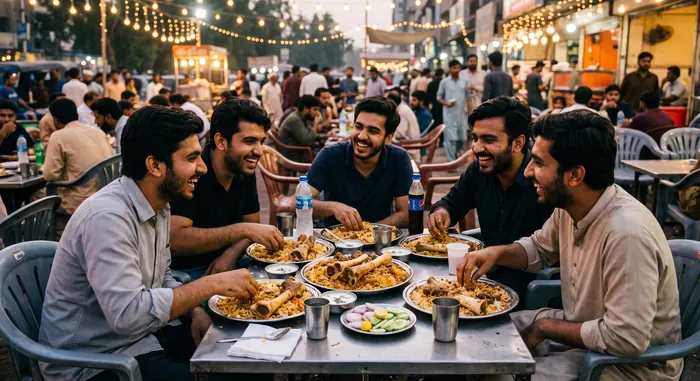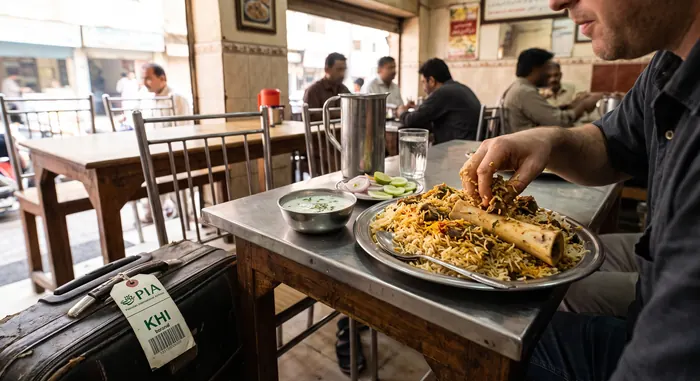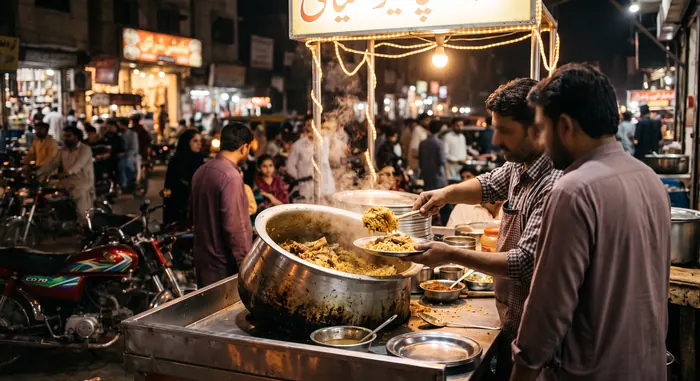
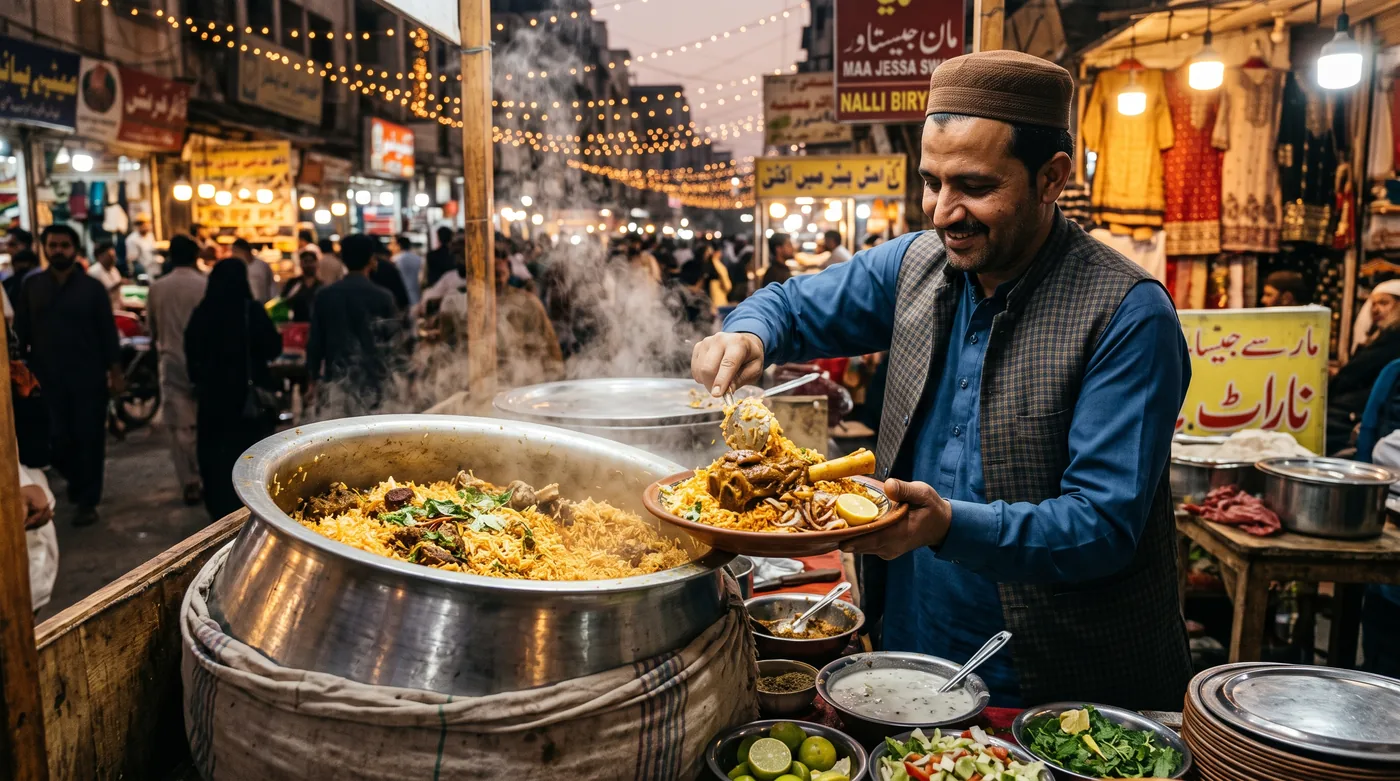
Long before "street food" became a genre that travelers chase across cities, Karachi's night bazaars were already serving something worth crossing the world for. In smoky lanes lit by string lights, vendors ladled rice and bone-in beef shank out of steel degh pots taller than a stool, and the smell alone was enough to stop foot traffic. Beef nalli biryani grew up in exactly that setting, and Ghousia Nalli Biryani, tucked into Main Sarafa Bazar in Liaquatabad, has been part of that story for years — one steaming pot, one plate, one customer at a time.
What makes it real street food
It isn't the setting that makes a dish street food, it's how it's cooked and served. A proper degh is never held overnight or reheated for a late order — it's meat sourced fresh that morning, masala balanced by hand, and rice cooked in batches sized to what actually sells that day. Portions are scooped to order in front of you, not plated in advance, which is why a good stall's pot empties out by evening rather than sitting half-full until closing.
The bone marrow is the whole point
What separates nalli biryani from an ordinary plate is the shank bone itself. Left whole and simmered for hours on low heat, the marrow inside softens until it's rich enough to scoop out with a spoon and stir straight into the rice. It takes longer to cook and costs more than boneless cuts, and there's no shortcut for it — rush the heat and the marrow stays hard instead of melting. If you want the full breakdown of why this cut changes the dish, our explainer on what makes nalli biryani different goes into the texture and technique in detail.
How the story travels
None of this spread through advertising. It moved the way street food stories usually do — a traveler posting a photo of the pot, an overseas Pakistani telling friends back home where to eat on their next visit, a food blogger stopping in Liaquatabad because someone else swore by it. That's also how Ghousia built its name well beyond the neighborhood it started in, while the kitchen itself hasn't changed: same address, same hands, same nalli simmering since morning. Our guide to ordering the best nalli biryani in Karachi is a good next stop if you're planning your first visit.
Bringing it home
We sell beef biryani and beef pulao in five sizes — 1 paou (Rs. 300), 1.5 paou (Rs. 450), 0.5 kg (Rs. 600), 3 paou (Rs. 900) and 1 kg (Rs. 1,200) — with nalli sold separately by the piece at Rs. 300, so you can add as many as your plate needs. Zarda, kheer, raita and salad round out the table. We're open Monday to Saturday, 11:00 AM to 11:00 PM, with delivery across Karachi from 12:30 PM to 10:00 PM, closed Sundays.
Quick answers
Is nalli biryani the same as regular beef biryani? No — nalli biryani keeps the bone-in shank whole and simmers it for hours so the marrow softens, while regular biryani uses boneless or mixed cuts that cook faster.
Can I order it if I'm visiting from outside Karachi? Yes. We deliver across the city, or you can visit the shop directly in Liaquatabad during opening hours.
How do I place an order? Message us on WhatsApp or call 0300 2106954, and we'll get a fresh pot ready for you.